Shift Left Testing: What It Really Means for Developers and QA
- 19 Jun 2026
There is a common misconception that Shift Left is just a way to pass QA responsibilities over to developers.
But that's not what it really means.
Rather than treating quality assurance as a final phase before release, Shift Left integrates quality discussions, testing, and feedback into the earliest stages of the Software Development Lifecycle (SDLC).
This allows teams to identify and address potential issues before they require complex, costly rework.
Ultimately, the goal is to build quality into the software from the start, rather than trying to test it all at the end.
What Shift Left Actually Means
To understand what this looks like in practice, visualize your development cycle as a timeline running from left to right. On the far right is your production release; on the far left is your initial planning phase.
Shifting left simply means moving your quality radar as close to that starting line as possible. It transforms QA from a reactive inspection at the end of the line into a proactive collaboration from day one.
A team is actively practicing Shift Left when they:
- Review requirements before development begins.
- Challenge assumptions and identify edge cases early.
- Define clear acceptance criteria.
- Discuss testability during design conversations.
- Consider security, performance, accessibility, and maintainability before implementation.
Finding a requirement gap during planning takes minutes. Finding the same issue in production may take hours or even days, so the earlier an issue is discovered, the cheaper and easier it is to fix.
What Shift Left Looks Like in Practice
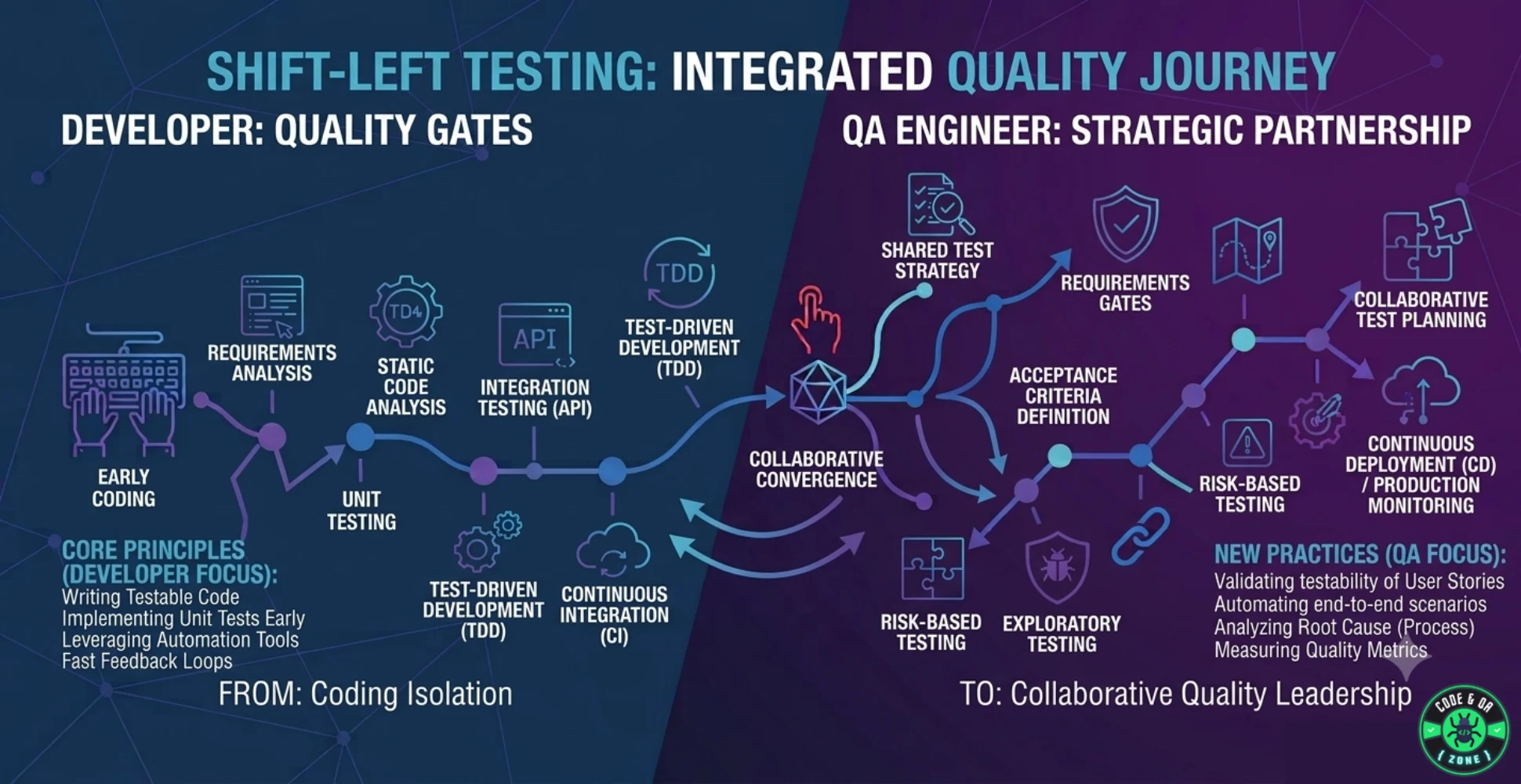
Quality is a shared responsibility, but roles still matter. Let's break it down:
For Developers
Developers own the quality of the code they build. Shift Left encourages developers to think beyond the "does the code work?"
It means to consider:
- Testability
- Maintainability
- Security
- Performance
- Long-term impact
In practice, this often includes meaningful unit tests, code reviews, component testing, and early validation of assumptions.
For QA
Shift Left doesn't make QA less important. If anything, it increases QA's influence on product quality because it can bring testing expertise, risk analysis, and quality guidance.
Instead of focusing primarily on finding bugs at the end of the cycle, QA can contribute earlier by:
- Reviewing requirements
- Identifying missing scenarios
- Identifying risks
- Defining acceptance criteria
- Designing quality strategies
- Helping improve testability
- Supporting automation strategies
- Performing exploratory testing
- Evaluating user experience risks
In mature teams, QA evolves from bug finder to quality advisor.
For PMs and Product Teams
For Product Managers and stakeholders, Shift Left creates better visibility, it helps to ensure requirements are clear, testable, and aligned with business goals in order to reduce risks.
How to Introduce Shift Left in Your Team
Shift Left is a mindset not a role change. You don't need a major organizational transformation to get started. A few practical steps can make a significant difference:
✅ Include QA in requirement and design discussions.
✅ Define clear and testable acceptance criteria.
✅ Encourage developers to own early testing activities.
✅ Automate fast feedback checks through CI/CD pipelines.
Common Shift Left Mistakes
Not every Shift Left implementation is successful because many organizations get it wrong. Some common pitfalls include:
❌ Treating Shift Left as a cost-cutting strategy.
❌ Using it as an excuse to reduce QA involvement.
❌ Turning developers into part-time QA analysts.
❌ Having QA engineers to write developers unit tests.
❌ Assuming more automation automatically means higher quality.
❌ Shifting responsibility from one team to another.
❌ Measuring success by the number of tests instead of product outcomes.
Shift Left is not a one-time process change. When implemented correctly, it improves collaboration and distributes quality ownership without removing role specialization.
Final Thoughts
The most important thing to remember is that Shift Left it's about moving feedback, learning, and quality thinking earlier in the development process.
The most successful teams don't wait until development is finished to start discussing quality. They bring quality conversations into requirements, planning, design, development, and testing activities from day one.