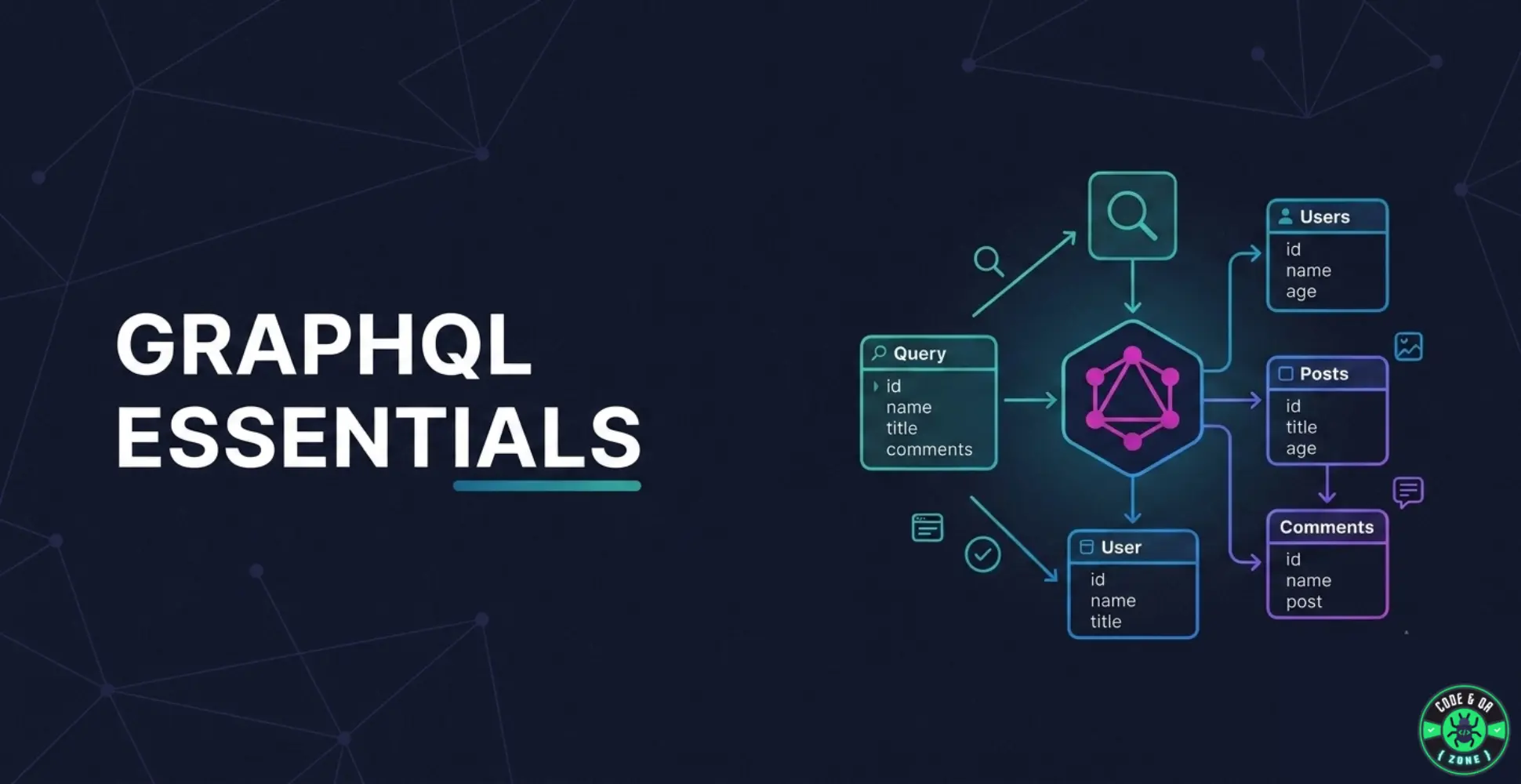
GraphQL Essentials: What It Is, How It Works and When to Use It Instead of REST
- 23 Mar 2026
Modern applications consume data from many sources and serve multiple clients like web, mobile, and beyond. Traditional API approaches sometimes struggle to efficiently deliver exactly what each client needs.
This is where GraphQL comes in.
This post introduces the essentials of GraphQL and sets the foundation for follow-up articles where we’ll explore other concepts in depth with examples.
What is GraphQL?
GraphQL was originally developed by Facebook (Meta) and open-sourced in 2015.
It is a query language for APIs and a server-side runtime that allows clients to request exactly the data they need from a single endpoint.
Instead of calling multiple endpoints and receiving fixed responses, clients describe the structure of the data they want, and the server returns precisely that structure.
Key aspects:
- One API endpoint
- Client-defined responses
- Strongly typed schema
- Efficient data fetching
Does GraphQL Replace REST?
No. GraphQL does Not replace REST. It is an alternative approach to building APIs.
REST organizes APIs around resources and endpoints, while GraphQL organizes APIs around data and relationships.
REST
- Multiple endpoints (
/users,/posts,/comments) - Fixed response structures
- Often requires multiple requests
GraphQL
- Single endpoint
- Flexible queries
- One request can fetch related data
Many modern systems use both together. GraphQL often sits between clients and existing REST or microservices, aggregating data into a unified API layer.
Why Does GraphQL Exist?
GraphQL was created to solve common API problems, especially for mobile and frontend-heavy applications:
- Over-fetching (receiving unnecessary data)
- Under-fetching (needing multiple requests)
- Network inefficiency on slow connections
- Difficulty supporting multiple client types
Mobile apps in particular, benefit from requesting only the data required, reducing bandwidth usage and improving performance.
How GraphQL Works
GraphQL models data as a graph (a collection of connected objects). Instead of navigating endpoints, clients navigate relationships between data.
Example
Let's say we have a blog API.
REST approach
- Request blog post
- Request author information
Two network calls are required.
GraphQL approach
A single query requests both post and author data at once.
Result: fewer requests and reduced network overhead.
Components of GraphQL
This section briefly introduces the main pieces. Each one of these are covered in detail in GraphQL Key Components Explained.
Schema
Defines the structure of the API (types, fields, and relationships). Think of it as the contract between client and server.
Types
Represent objects in your system (User, Post, Comment, etc.).
Query
Used to fetch data from the API.
Mutation
Used to create, update, or delete data.
Subscription
Allows real-time updates via a persistent connection.
Resolvers
Functions that fetch the actual data for each field in a query.
Endpoint
All operations are sent to a single endpoint, typically via HTTP POST. GraphQL responses are usually returned as JSON matching the requested structure.
Advantages of GraphQL
- Fetch exactly the data needed
- Reduce multiple API calls
- Strong type system reduces errors
- Flexible for multiple clients (web, iOS, Android)
- Suitable for managing complex microservices
Disadvantages of GraphQL
- Increased implementation complexity
- More challenging caching compared to REST
- Requires careful query performance management
- Learning curve for teams new to schema-driven APIs
note
GraphQL is powerful, but not always the best or simplest solution.
Best Practices for GraphQL API Design
-
Think in graphs, not endpoints -> Model relationships between entities instead of isolated resources.
-
Document your schema -> Use descriptions so APIs can be self-explanatory.
-
Paginate list fields -> Avoid returning large datasets in a single query in order to avoid large payloads.
-
Deprecate instead of versioning -> Use the @deprecated directive to evolve APIs safely.
-
Consider hybrid architectures -> Combining GraphQL with REST can provide a good balance in your system.
Final Thoughts
GraphQL introduces a flexible and modern way for clients and servers to communicate.
By allowing clients to request exactly the data they need, GraphQL reduces unnecessary network traffic and improves developer experience. Its strong typing, single endpoint model, and support for real-time data make it especially valuable for modern applications.
However, GraphQL is not a universal replacement for REST, it’s another tool with its own strengths and trade-offs.
Make sure to continue with GraphQL Key Components Explained, where e talk in detail about each one using a practical example.